- Energy conversion “switch master”
The core process of electromagnetic induction heating is:
DC-AC conversion: IGBT acts as a high-speed switch to convert rectified DC (e.g., 310V DC) into high-frequency AC (20-100kHz), which drives the induction coil to generate an alternating magnetic field.
Switching frequency control: By adjusting the switching frequency of the IGBT (e.g. 20-40kHz), the magnetic field frequency can be precisely controlled, which in turn affects the eddy current density and heating depth. Under high frequency, the eddy current is concentrated on the surface layer of the workpiece to realize “surface quenching” and other processes; low frequency is suitable for deep heating.
Duty Cycle Adjustment: By adjusting the ratio of IGBT on-time to cycle (duty cycle), the output power can be controlled linearly. For example, increasing the duty cycle can extend the on-time and increase the heating power.
- Key Performance Parameters Support High Frequency Applications
The voltage withstand, current capacity and switching loss characteristics of IGBTs make them ideal for high frequency induction heating:
Withstand voltage and current capacity: In industrial equipment, IGBTs are subjected to hundreds of volts and tens of amps of current. For example, Ruineng Semiconductor’s WG30R135W1 (1350V/30A) and WG30R140W1 (1400V/30A) products can meet the demanding needs of complex scenarios such as induction cooktops.
Low conduction loss: IGBT on-time voltage is reduced (about 1-3V), which significantly reduces energy waste. For example, in induction cooktops, the low loss design can reduce the overall power consumption and improve the energy efficiency level.
Fast turn-off capability: IGBTs can be turned off in nanoseconds, avoiding energy loss during the switching transition and improving system efficiency.
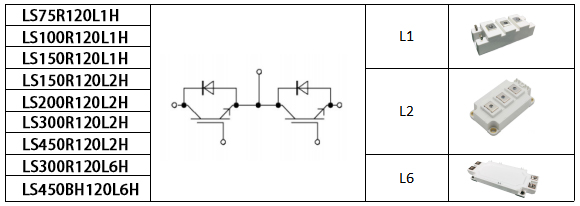
Typical application scenarios of IGBT in induction heating
- Home appliance field: the “efficiency revolution” of induction cooker
Induction cooker is a typical application of IGBT in home appliance, and its core advantages are:
High-efficiency heating: IGBT converts utility power (220V/50Hz) into high-frequency alternating current (AC), which drives the coil to generate a magnetic field and directly heats the pots and pans, reducing heat conduction losses. For example, the thermal efficiency of induction cooker with IGBT can reach over 90%, much higher than 60% of gas cooker.
Precise temperature control: By adjusting the switching frequency and duty cycle of IGBT, the temperature control precision of ±1℃ can be realized to meet the diversified cooking needs of frying, stir-frying, stewing and so on.
Safety and reliability: IGBT’s over-current and over-voltage protection functions (such as cycle-by-cycle current limitation and active clamp control) can prevent the equipment from being damaged due to abnormal working conditions (such as removal of pots and pans and fluctuations in the power grid) and prolong its service life.
- Industrial field: “Precision craftsmen” for metal heat treatment
In industrial heating scenarios, IGBTs support the whole process from quenching to welding:
High-frequency quenching: IGBT-driven high-frequency induction heating equipment (e.g., 20-60kHz) can realize the surface quenching of gears, bearings and other parts, with a controllable depth of hardened layer to enhance wear resistance. For example, an enterprise adopts IGBT ultra-audio power supply (30kW/30kHz) to realize local quenching of roller bearings, and the process success rate reaches 100%.
Hot heading of bolts: IGBT medium frequency induction heating equipment (1-8kHz) can quickly heat up bolts to forging temperature and improve production efficiency. For example, a factory adopts IGBT IF furnace (750kW/8kHz) to realize hot heading of high strength bolts, and the heating time of a single piece is reduced to 3 seconds.
Diamond drill bit welding: IGBT high-frequency equipment (450kHz) can realize precise welding of diamond composite piece and drill bit, avoiding the expansion of heat-affected zone and improving welding quality. For example, an enterprise adopts IGBT high-frequency welding machine (800kW/450kHz) to weld diamond drill bits, and the yield rate is increased to 99%.
Technical Challenges and Solutions
- Loss Control at High Frequencies
IGBTs generate switching losses (Eoff) when switching at high frequencies, affecting efficiency. Solutions include:
Soft-switching technology: Reducing switching transition losses through zero-voltage switching (ZVS) or zero-current switching (ZCS) modes. For example, induction cooktops using soft-switching topologies (e.g. SEPR) can reduce switching losses by more than 50%.
Low-loss materials: The use of IGBTs that combine a field cutoff layer with a trench gate structure (e.g., RC-IGBTs) can significantly reduce conduction and switching losses. For example, the RC-IGBT products of Ruineng Semiconductor reduce losses by 30% compared with conventional solutions.
- Protection mechanism under extreme operating conditions
IGBTs may face extreme operating conditions such as overcurrent, overvoltage, and overtemperature in induction heating. Solutions include:
Full protection integration: Using IGBT modules with integrated over-voltage, over-current and over-temperature protection functions (such as Infineon F-series fully protected IGBTs), real-time monitoring of anomalies and cut off the drive signal to prevent damage to the device.
Active clamp control: By dynamically adjusting the IGBT on-time, the collector voltage is clamped within a safe range to avoid over-voltage breakdown. For example, active clamping can limit voltage spikes and protect IGBTs when pots and pans are removed.
Future Trends: SiC Fusion and Intelligence
- SiC Hybrid Integration Technology
SiC (Silicon Carbide) material has high voltage withstanding and low-loss characteristics, and combining it with IGBTs can further improve system efficiency. For example, SiC MOSFET and IGBT hybrid modules can reduce switching losses by 50%, and are suitable for high-frequency and high-temperature scenarios (e.g., electric vehicle motor drives). In the future, SiC-IGBT hybrid technology is expected to realize smaller size and higher power density design in electromagnetic induction heating. - Intelligent Control and Predictive Maintenance
By integrating sensors and AI algorithms, IGBT systems can realize:
Real-time health monitoring: monitor IGBT junction temperature, current waveform and other parameters to predict the risk of failure.
Adaptive control: Dynamically adjust the switching frequency and duty cycle according to the load characteristics to optimize the heating efficiency.
Remote operation and maintenance: Realize remote monitoring and fault diagnosis of equipment through the Internet of Things (IoT), reducing maintenance costs.
Conclusion
IGBT, as the core device of electromagnetic induction heating technology, has driven changes in the fields of home appliances, industry, and scientific research with its high-frequency, high-efficiency, and controllable characteristics. From the precise cooking of induction cookers to the precision process of metal heat treatment, IGBT is continuing to expand the application boundaries with technological innovation. In the future, with the deepening of silicon carbide fusion and intelligent control, IGBT will further empower induction heating and provide key support for global energy transformation and high-end manufacturing upgrade.